Use this page as a reference. Terms are grouped by topic, and each links to a guide where we explain it properly.
Attribution Basics
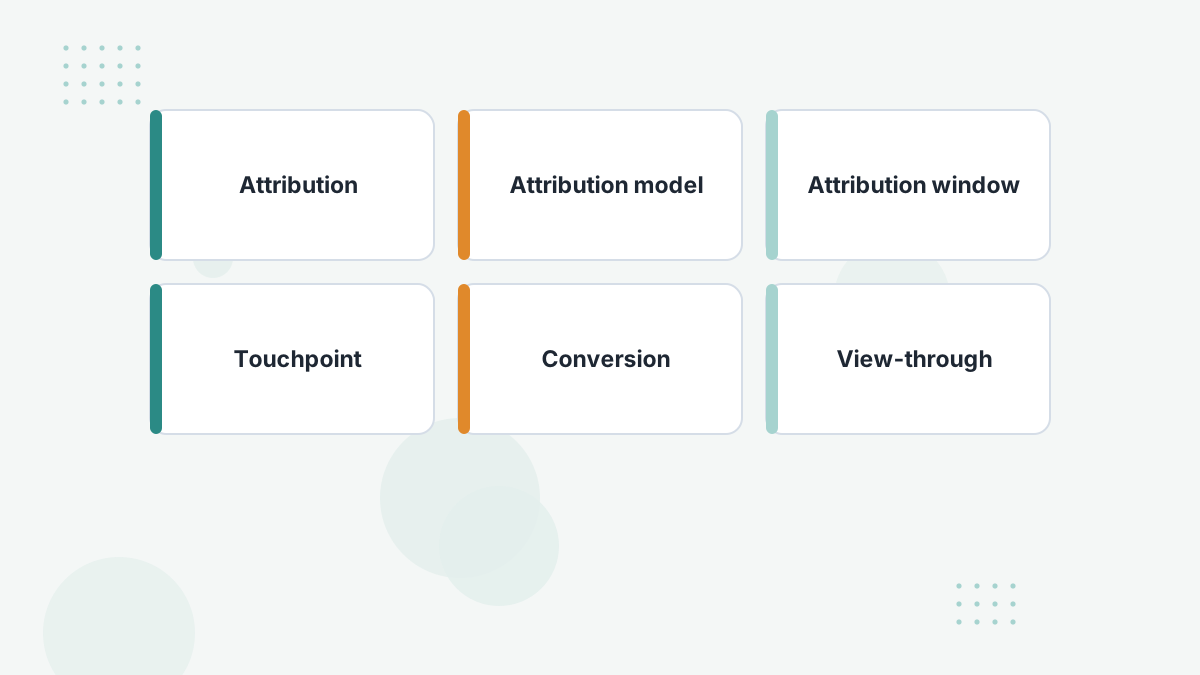
- Attribution
- Assigning credit for a conversion to the marketing touches that led to it. See ad attribution.
- Attribution model
- The rule for splitting credit, such as first click, last click or linear. See attribution models.
- Attribution window
- How long after an ad interaction a conversion can still be credited. See attribution windows.
- Touchpoint
- Any interaction with your marketing: an ad click, email click or site visit.
- Click-through conversion
- A conversion after someone clicked an ad.
- View-through conversion
- A conversion after someone saw an ad without clicking.
- Engage-through attribution
- Meta's 2026 window for conversions after an engagement short of a link click. See Meta attribution settings.
Models and Methods
- First click and last click
- Single-touch models crediting the first or final touch. See first touch vs last touch.
- Multi-touch attribution (MTA)
- Sharing credit across several touches. See multi-touch attribution.
- Data-driven attribution
- Algorithmic credit based on patterns in your data. See data-driven attribution.
- Media mix modeling (MMM)
- Statistical modeling of channel impact from aggregate data. See MMM vs MTA.
- Incrementality
- Sales an ad caused that wouldn't have happened otherwise. See incrementality testing.
- Self-reported attribution
- Asking customers how they heard about you. See self-reported attribution.
Tracking Technology
- Pixel
- A browser script that reports visits and conversions to a platform.
- Server-side tracking
- Sending conversions from your server rather than the browser. See server-side tracking.
- Conversions API (CAPI)
- Meta's server-side event channel. See Facebook Conversions API.
- Events API
- TikTok's server-side event channel. See TikTok Events API.
- Enhanced conversions
- Google's matching of hashed customer data to conversions. See enhanced conversions.
- Offline conversions
- Sales or outcomes imported from your CRM. See Google offline conversions.
- Click ID
- An identifier added to ad links, such as gclid, fbclid or ttclid.
- UTM parameters
- Tags on links describing source, medium and campaign. See UTM parameters.
- Deduplication
- Ensuring the same conversion sent by pixel and server is counted once.
- Event match quality
- Meta's score for how well server events match to users.
- Deterministic matching
- Linking sessions using exact identifiers like email. See cross-device tracking.
- Probabilistic matching
- Linking sessions using similar signals like IP and device traits.
- Print tracking
- Hyros's name for its identity-based, server-side tracking. See how Hyros works.
Privacy and Consent
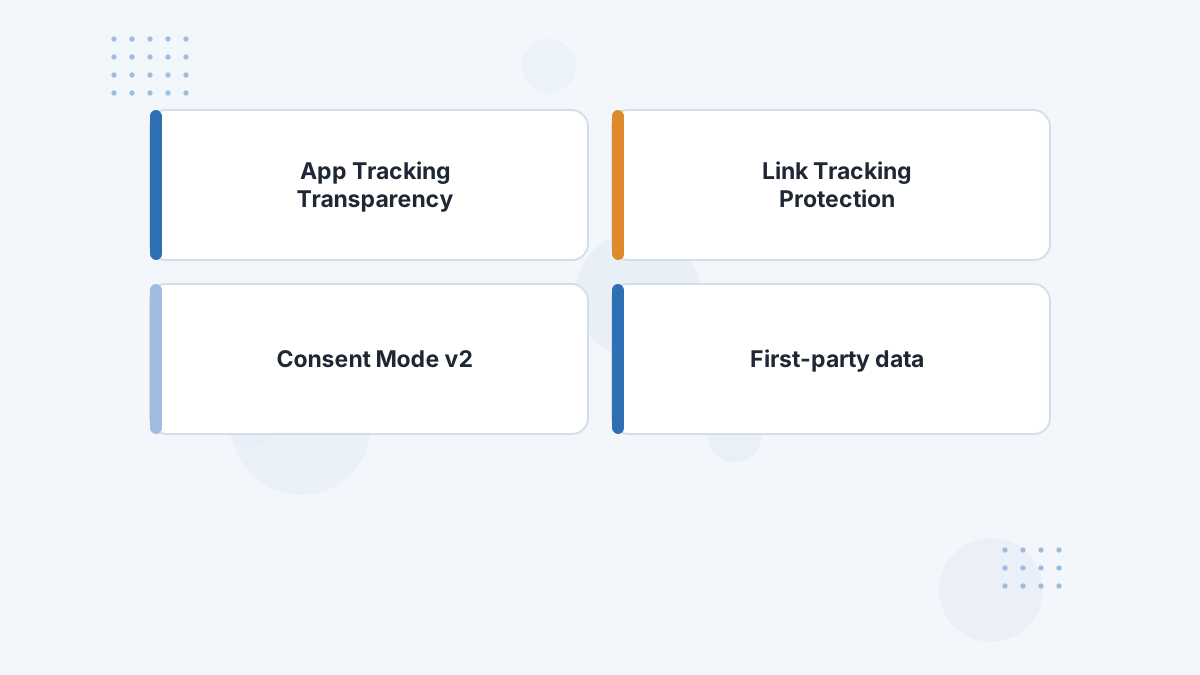
- App Tracking Transparency (ATT)
- Apple's iOS opt-in for cross-app tracking. See iOS tracking changes.
- Link Tracking Protection
- Apple's feature removing known tracking parameters in certain contexts.
- Consent Mode v2
- Google's framework for adjusting tags to consent choices. See cookie consent.
- First-party data
- Data you collect directly from customers, such as emails at opt-in.
- Modeled conversions
- Platform estimates of conversions they couldn't observe directly.
Metrics
- ROAS
- Return on ad spend: revenue ÷ ad spend. See ROAS.
- Break-even ROAS
- The ROAS where ads neither make nor lose money. See break-even ROAS.
- MER
- Marketing efficiency ratio: total revenue ÷ total ad spend. See MER vs ROAS.
- POAS
- Profit on ad spend: gross profit ÷ ad spend. See POAS.
- CAC
- Customer acquisition cost: spend ÷ new customers. See CAC.
- CPA
- Cost per acquisition or action, usually per conversion event.
- LTV
- Lifetime value: what a customer is worth over time. See LTV.
- Cohort
- A group of customers acquired in the same period or from the same source.
Funnels and Sales
- Booked call
- A scheduled sales call, often the key conversion in coaching and B2B. See tracking sales calls.
- Show rate
- The share of booked calls that are attended.
- Lead quality
- How likely leads are to become customers. See tracking leads.
- Webinar funnel
- A funnel where registration and viewing precede the offer. See webinar funnel tracking.
Glossary FAQs
What's the difference between ROAS and MER?
ROAS uses attributed revenue for a campaign; MER uses total revenue for the business.
What's the difference between MTA and MMM?
MTA credits tracked touches per buyer; MMM models channel impact from aggregate data.
What is a click ID?
An identifier platforms add to ad links, like gclid or fbclid, used to tie conversions to clicks.
Where should a beginner start?
Read our ad attribution guide, then attribution models.