Most buyers don't convert on their first visit. They see an ad, research, leave, come back via another channel, and eventually buy. Single-touch reporting picks one moment and ignores the rest. Multi-touch attribution tries to credit them all.
What Is Multi-Touch Attribution?
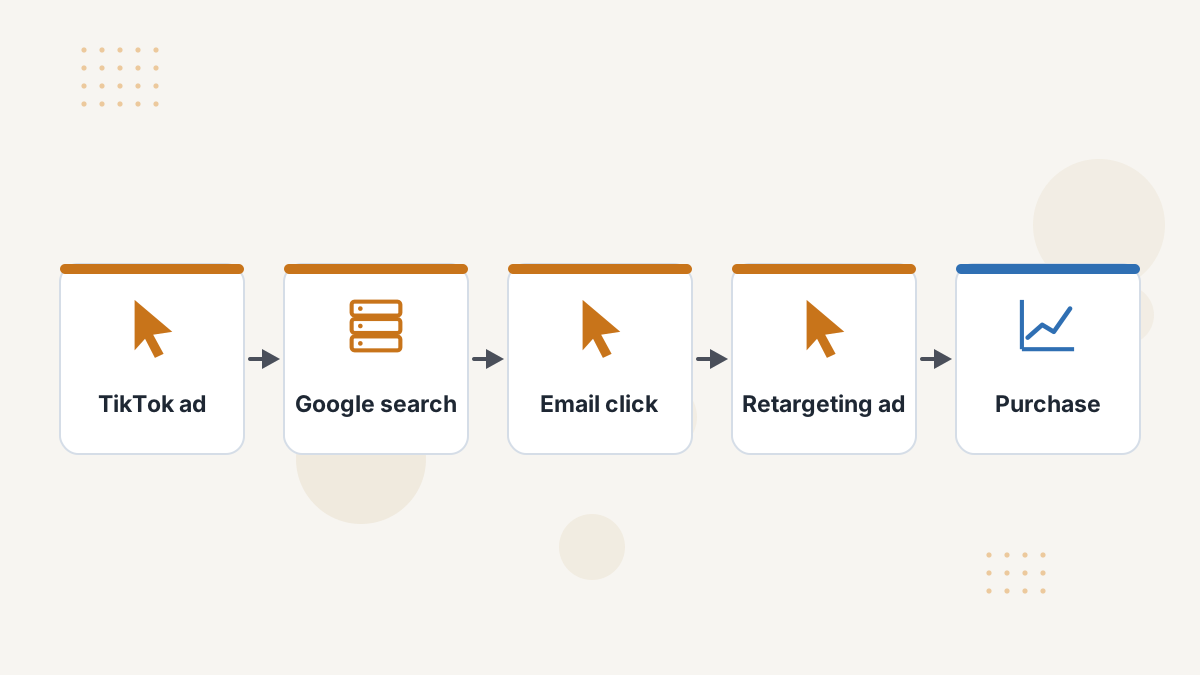
Multi-touch attribution is a method of assigning fractional credit for a conversion to each marketing touchpoint in the buyer's journey. Instead of "this sale came from the retargeting ad", MTA says "40% to the TikTok ad that introduced them, 20% to search, 10% to email, 30% to retargeting", or whatever split your model uses.
Why it matters to you: it stops you starving the channels that start journeys, and stops you over-feeding the ones that only close them.
How Multi-Touch Attribution Works
- Capture touches. Record each ad click, visit and email click with its source.
- Stitch the journey. Connect those touches to one person, ideally across devices.
- Record the conversion from a reliable source such as your checkout or CRM.
- Apply a model to split credit between the touches.
- Report revenue by channel, campaign and ad based on that split.
Step two is where most setups fail. If a journey can't be stitched across devices and sessions, MTA only sees fragments. See cross-device tracking.
Rule-Based vs Data-Driven Models
| Model | How Credit Is Split | Best For |
|---|---|---|
| Linear | Equally across all touches | A neutral starting view |
| Time decay | More credit to touches closer to the sale | Short sales cycles |
| Position-based (U-shaped) | Most credit to first and last, rest shared | Valuing openers and closers |
| Custom weights | Your own split between first, assists and last | Agreed team standard |
| Data-driven | Statistical modeling of each touch's contribution | Large data volumes |
Rule-based models are transparent: you know exactly why each channel got its credit. Data-driven models adapt to your data but can be opaque. See attribution models explained and data-driven attribution.
What MTA Needs to Work

- Consistent tagging so every visit has a known source. See UTM parameters.
- Tracking on every page buyers pass through.
- Identity, like an email captured early, to stitch devices together.
- Server-side conversion data from your checkout, processor or CRM. See server-side tracking.
Limits of Multi-Touch Attribution
MTA can only credit touches it can see. A podcast mention, a TV ad or a video watched without clicking won't appear. Privacy settings can also hide some touches.
That's why larger advertisers combine MTA with media mix modeling, incrementality tests and post-purchase surveys. For most performance advertisers, well-tracked MTA answers the day-to-day questions.
How to Use MTA Well
- Compare views: look at first click, last click and your multi-touch model side by side.
- Agree one model for weekly budget meetings so everyone reads the same numbers.
- Match windows to your cycle: long journeys need long windows.
- Judge on revenue, including repeat purchases, not just first orders.
Tools like Hyros let you change models without re-tracking, because the underlying journeys stay the same.
Multi-Touch Attribution FAQs
Is multi-touch attribution accurate?
It's as accurate as the tracking behind it. With identity matching and server-side conversions, it's far better than single-touch reporting.
Which multi-touch model is best?
Position-based or custom weights are good starting points; compare with first and last click.
What's the difference between MTA and MMM?
MTA credits tracked touches per buyer; MMM models channel impact statistically from aggregate data.
Do ad platforms offer multi-touch attribution?
Each only sees its own touches, so true cross-channel MTA needs an independent tool.
Credit Every Touch Fairly
Book a Hyros demo to see multi-touch attribution across all your ad platforms.
Book a Hyros Demo