Picture one buyer: they click a TikTok ad, later search your brand on Google, open two emails, then click a Meta retargeting ad and buy for $200. Every model below splits that $200 differently. We'll use this journey as the example throughout.
Single-Touch Models
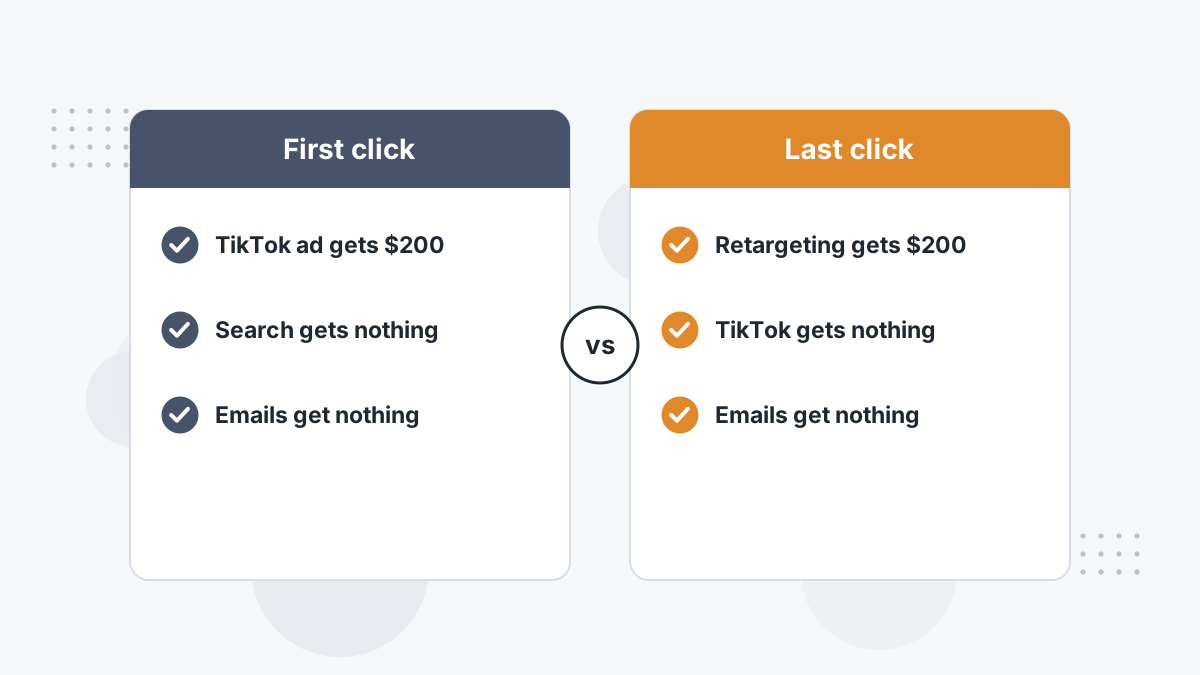
First Click
All $200 goes to the TikTok ad that started the journey. It's the best lens for prospecting and cold traffic, because it shows which ads introduce future buyers.
Last Click
All $200 goes to the Meta retargeting ad. It shows what closes sales, but over-credits retargeting, email and branded search, which often catch people who were already going to buy.
Last Non-Direct Click
A variation that ignores direct visits and credits the last marketing touch. It's what many analytics tools defaulted to for years.
Multi-Touch Models
Linear
Five touches, so each gets $40. Neutral and simple, but treats a passing email the same as the ad that started everything.
Time Decay
Touches closer to the sale get more. The retargeting ad might get $80 and the TikTok ad $15. Suits short cycles; undervalues prospecting in long ones.
Position-Based (U-Shaped)
Commonly 40% to first, 40% to last and 20% shared across the middle: TikTok $80, retargeting $80, the three middle touches about $13 each. A popular balanced choice.
Custom Weights
You decide the split between first touch, assists and last touch. Good for setting a team standard. See how Hyros handles custom weights.
Data-Driven Attribution
Data-driven models use statistical analysis of many journeys to estimate each touch's contribution. Google Analytics 4 uses data-driven attribution as its default.
They adapt to your data, but they're less transparent and only work on journeys the tool recorded. See data-driven attribution.
Models Compared
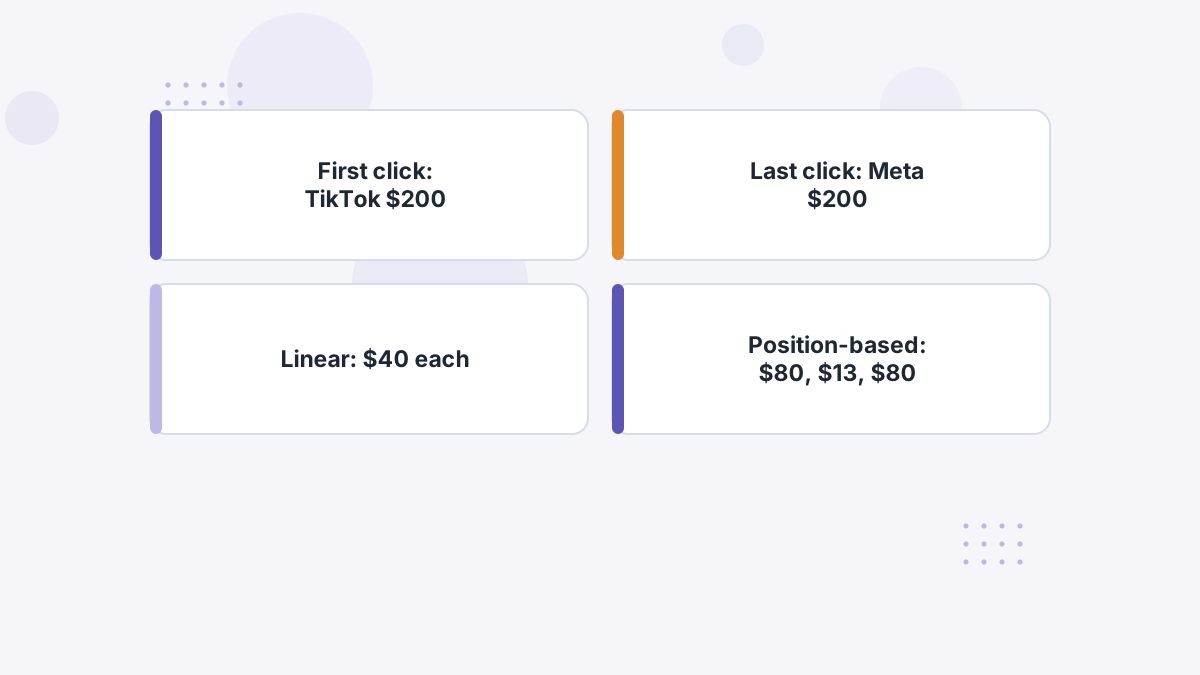
| Model | TikTok Ad | Middle Touches (3) | Meta Retargeting |
|---|---|---|---|
| First click | $200 | $0 | $0 |
| Last click | $0 | $0 | $200 |
| Linear | $40 | $40 each | $40 |
| Position-based (40/20/40) | $80 | About $13 each | $80 |
Same journey, wildly different conclusions about TikTok. That's why the model you use shapes your budget.
Which Model Should You Use?
Judging Prospecting
First click, with a long window.
Judging Retargeting and Email
Last click, cross-checked with first click.
Weekly Budget Reviews
Position-based or agreed custom weights.
Large Data, Google-Heavy
Data-driven, alongside a transparent model.
The real win is comparing views. Read first touch vs last touch next.
Models Only Work With Good Tracking
A model can only split credit among touches that were recorded. If journeys break across devices or sales happen on calls, every model is working with partial data. Fix tracking first. See multi-touch attribution and server-side tracking.
Attribution Model FAQs
What is the most common attribution model?
Last click has historically been most common; data-driven is now the default in GA4.
Which model is best for ecommerce?
Compare first and last click, then use position-based or custom weights for decisions.
Does the model change your data?
No, only how credit is divided among the same touches.
Why does first click make prospecting look better?
Because it credits the ads that start journeys, which last click ignores.
See Your Journeys Through Every Model
Book a Hyros demo and compare attribution models on your own data.
Book a Hyros Demo