Rule-based models like first click or linear are transparent but arbitrary. Data-driven attribution tries to learn the right split from your data. That sounds ideal, but its quality depends on what it can see.
How Data-Driven Attribution Works
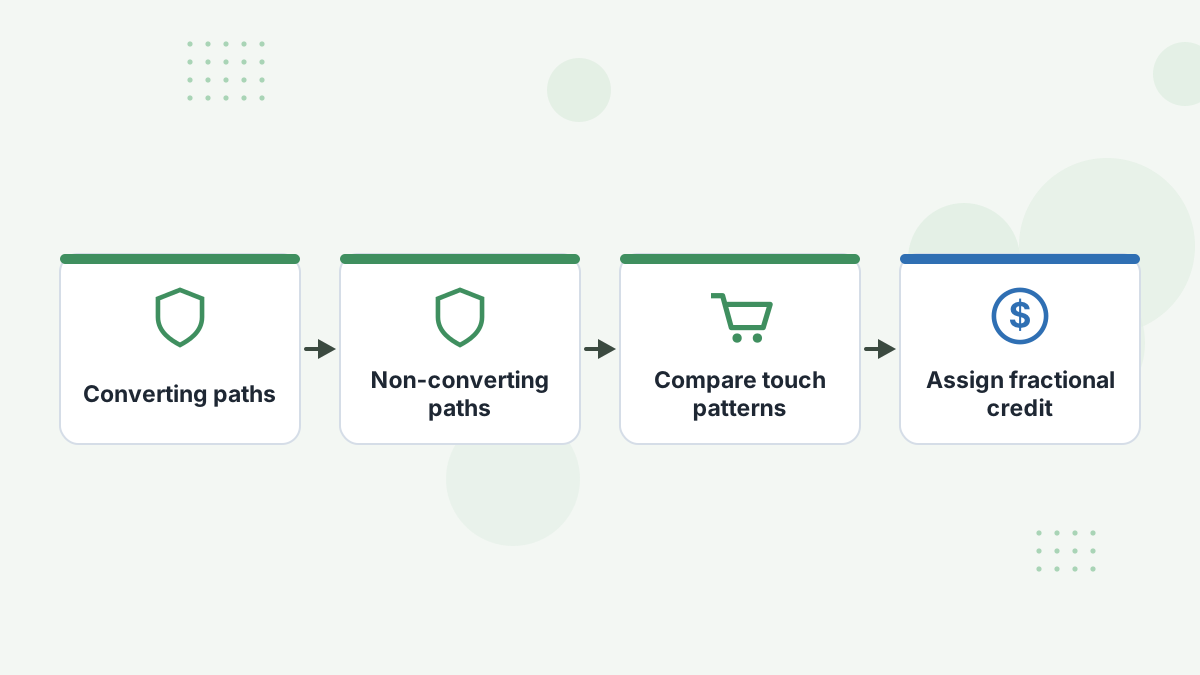
Data-driven models compare the paths of people who converted with the paths of people who didn't. If a touchpoint appears more often in converting paths, and its presence seems to raise the chance of conversion, it receives more credit.
Google's implementation uses this approach in both Google Ads and GA4, distributing fractional credit across interactions.
What It Needs to Work
- Enough data: algorithms need substantial conversion volume to estimate contributions reliably.
- Good tracking: it can only weigh touches it recorded.
- Stable conditions: rapid changes in campaigns or tracking make estimates noisier.
Small accounts may see results that swing week to week, or that look much like last click.
Strengths
- Adapts to your actual customer behavior rather than a fixed rule.
- Gives credit to assisting touches that last click ignores.
- Integrates directly with Google bidding.
Blind Spots
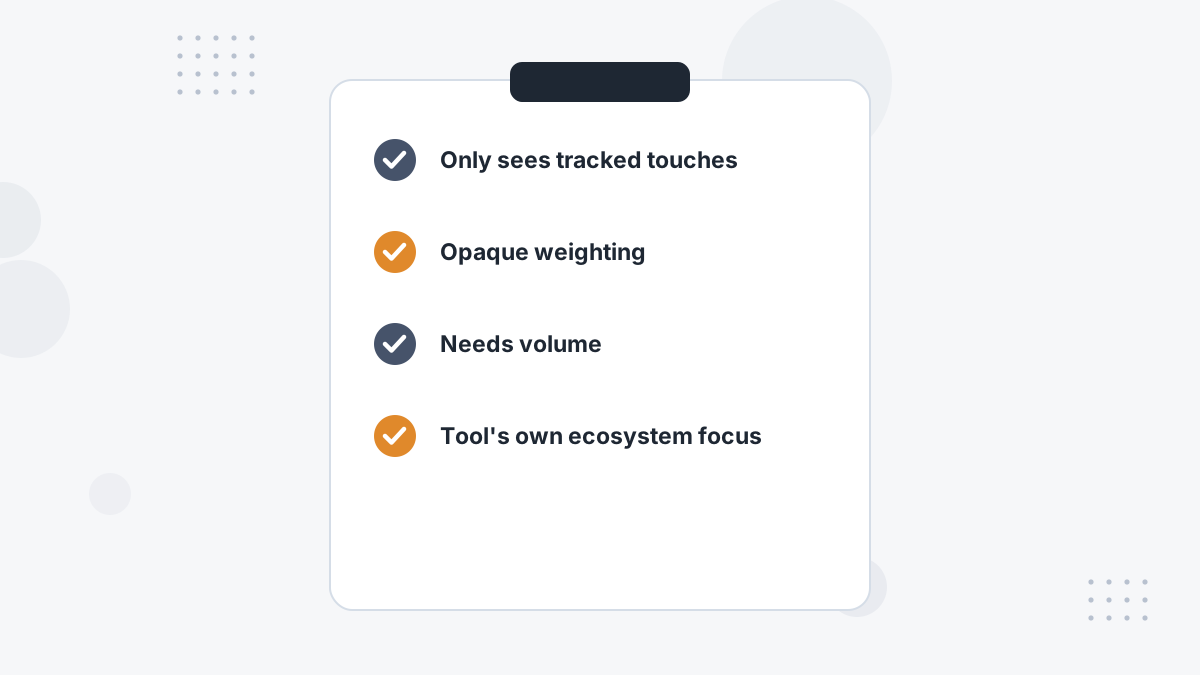
- Opacity: you can't easily see why a channel got its credit.
- Visibility limits: touches lost to consent, privacy or device switching aren't in the data.
- Correlation, not causation: it estimates association with conversion, which isn't the same as proving an ad caused sales. See incrementality testing.
- Ecosystem bias: a Google tool sees Google interactions most completely.
How to Use It Sensibly
- Compare with transparent views such as first and last click.
- Check against real revenue rather than trusting totals.
- Improve tracking first: consent, UTMs and server-side events.
- Use experiments for big budget questions.
Data-Driven Attribution FAQs
Is data-driven attribution better than last click?
Usually more balanced, but less transparent and dependent on data volume and tracking quality.
Where is it used?
It's the default model in GA4 and Google Ads.
Does it prove ads caused sales?
No. It estimates contribution from patterns; experiments test causation.
Can small accounts use it?
They can, but results may be noisy with low conversion volume.
See Attribution You Can Explain
Book a Hyros demo to see transparent, cross-platform attribution on your data.
Book a Hyros Demo