Our Verdict
Keep GA4 no matter what. It's free, it integrates with Google Ads, and it's the best general view of how people use your site.
Add Hyros when you spend meaningfully on paid social, sell through calls or long funnels, or need sales sent back to Meta and TikTok as well as Google. That's where GA4's browser-based, Google-centric design leaves gaps.
"Why pay for attribution when GA4 is free?" is a fair question. The honest answer is that GA4 and Hyros do different jobs, and many businesses run both.
The Core Difference
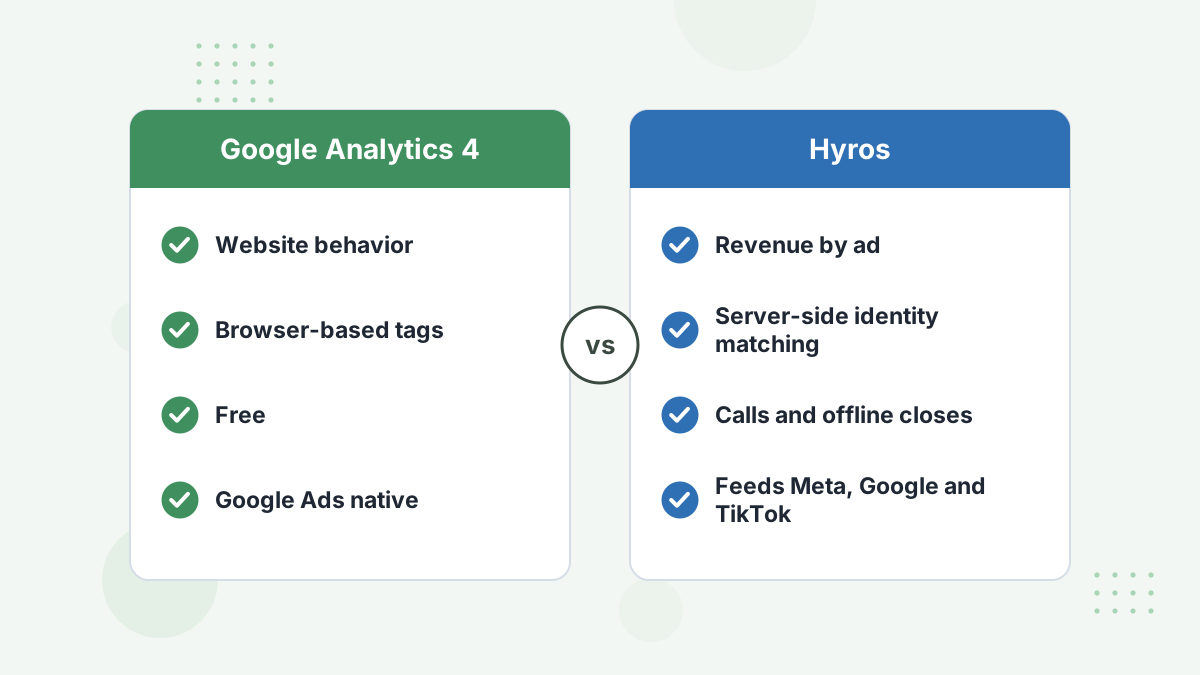
GA4 measures sessions, events and users on your website and app. It attributes conversions to channels and campaigns, and it integrates natively with Google Ads.
Hyros measures revenue by ad. It matches sales, calls and renewals to the people who clicked your ads using first-party identifiers server-side, then sends those matched sales back to the ad platforms.
What this means for you: GA4 tells you how your site performs and how Google channels contribute. Hyros tells you which specific ads across every platform produced real revenue.
Hyros vs GA4 Side by Side
| Area | GA4 | Hyros |
|---|---|---|
| Cost | Free | Paid, by tracked revenue |
| Primary data source | Browser tag on your site | Server-side matching plus your script |
| Ad blockers and consent | Can reduce data | Server-side sales reports unaffected |
| Attribution models | Data-driven and last click | First click, last click, custom weighting |
| Ad-level spend and ROAS | Native for Google Ads; others via imports | Pulled from all connected ad platforms |
| Calls and offline closes | Requires custom setup | Native call tracking and CRM integrations |
| Feedback to ad platforms | Google Ads | Meta, Google, TikTok |
Where GA4 Falls Short for Paid Ads
GA4 is excellent at what it's built for, but three gaps matter to advertisers:
- Browser dependence. GA4 relies on a tag in the visitor's browser, so ad blockers, consent choices and cookie limits reduce what it records.
- Cross-device journeys. Without users signing in, a phone click and a laptop purchase can look like two different people.
- Offline revenue. Sales closed on calls or by invoice need custom imports to appear.
There's also a perspective issue. GA4 is a Google product that integrates most deeply with Google Ads. For Meta and TikTok, it works from UTM-tagged clicks, which miss view and in-app behavior. Our GA4 attribution guide covers what it does well.
Where Hyros Adds Value
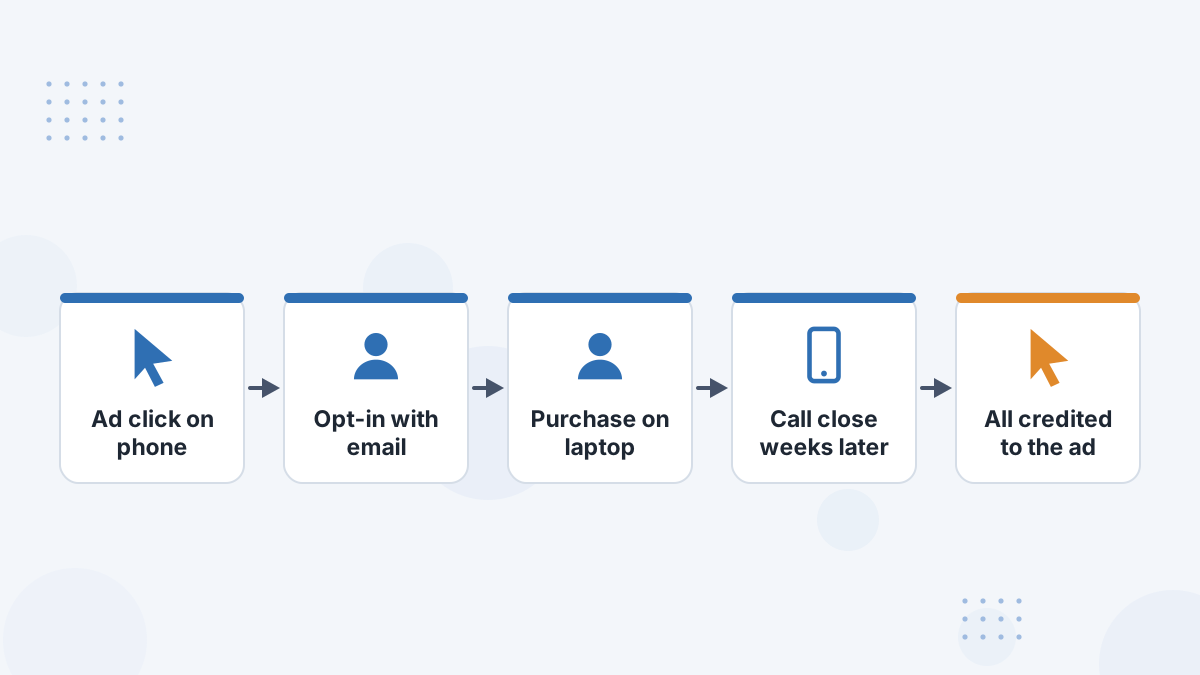
Hyros fills those gaps by working from identity rather than sessions. When a lead enters an email, Hyros can tie their earlier clicks and later purchases together, even across devices and weeks.
Sales arrive from your cart, processor and CRM server-to-server, so browser restrictions don't affect them. And because Hyros sends matched conversions to Meta, Google and TikTok, every platform's algorithm learns from the fuller picture.
See how Hyros works for the mechanics.
Attribution Models Compared
GA4's default is data-driven attribution, which uses Google's modeling to distribute credit across touchpoints, with last click also available. It's convenient but opaque, and it only sees journeys GA4 recorded.
Hyros lets you choose first click, last click or a custom weighting across first touch, assists and last touch, applied to identity-matched journeys. You can see exactly how credit was assigned.
Neither is "right". The useful habit is to compare first-click and last-click views when deciding on prospecting versus retargeting budgets. See data-driven attribution and attribution models explained.
Using GA4 and Hyros Together
Most businesses that add Hyros keep GA4. A sensible split:
- GA4 for site behavior, landing page performance, content and organic analysis, and Google Ads integration.
- Hyros for ad-level revenue across platforms, LTV, calls, and feeding real sales back to the ad networks.
Expect the two to disagree on conversions. They use different data, windows and models. Reconcile both against your actual revenue rather than against each other.
When to Upgrade From GA4 to Hyros
You Spend Across Several Platforms
And can't trust each platform's self-reported results.
You Sell on Calls
And need closes tied to the ads that started them.
Your Buyers Take Weeks
And cross devices before they purchase.
You're Scaling Weekly
And a wrong budget decision costs more than the tool.
If none of these apply, GA4 plus clean UTM tagging is a reasonable place to start. See also small business attribution options.
Hyros vs Google Analytics FAQs
Can GA4 replace Hyros?
For simple, single-channel funnels, GA4 can be enough. For multi-platform spend, calls and long journeys, it leaves gaps Hyros is built to fill.
Should you remove GA4 after adding Hyros?
No. GA4 remains valuable for site analytics and Google Ads integration.
Why do Hyros and GA4 show different numbers?
They use different tracking methods, attribution models and windows. Compare both to real revenue.
Is GA4 data-driven attribution accurate?
It's useful but limited to journeys GA4 recorded, and its modeling isn't transparent.
Go Beyond What GA4 Can See
Book a Hyros demo to see ad-level revenue across every platform, including calls and renewals.
Book a Hyros Demo