Our Verdict
Choose Polar Analytics if you're a Shopify brand that wants a full ecommerce data stack: dashboards, a dedicated Snowflake warehouse, AI agents and incrementality tests, with attribution as one part.
Choose Hyros if your priority is trustworthy ad-level revenue across many platforms and funnels, including calls, subscriptions and non-Shopify checkouts, with conversion feedback to the ad platforms.
Polar Analytics and Hyros both appear on Shopify brands' shortlists, but they're built for different jobs. Polar wants to be your data infrastructure; Hyros wants to be your source of truth for ad attribution.
The Core Difference
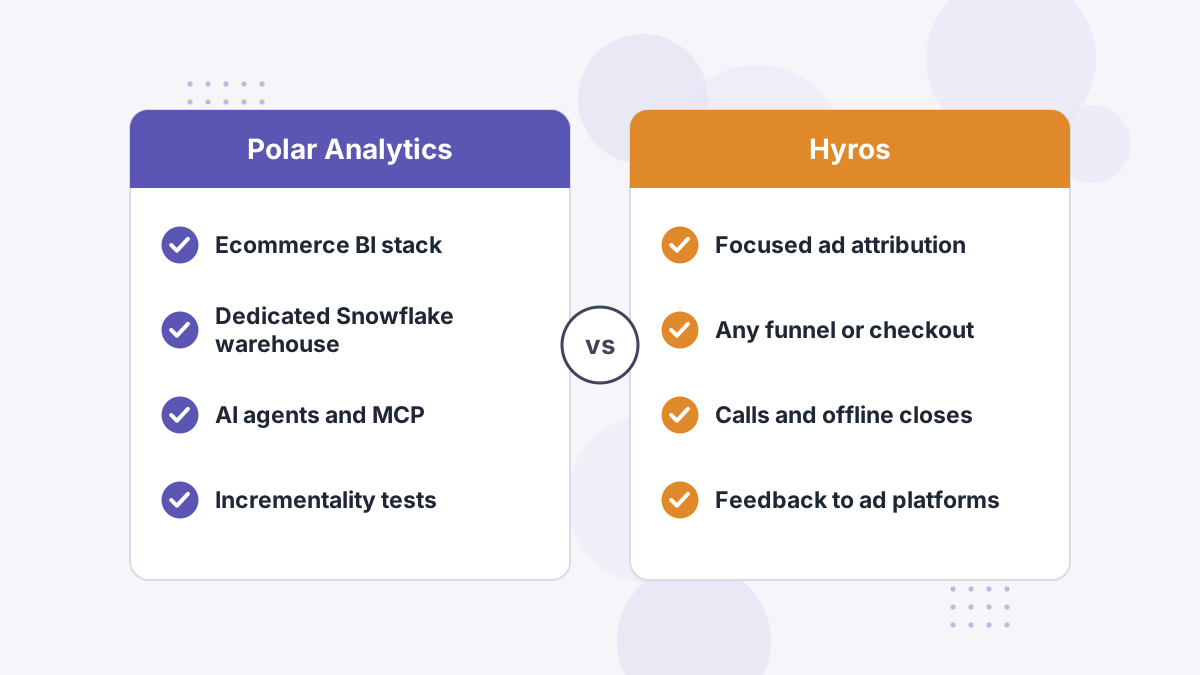
Polar Analytics bundles business intelligence, a first-party pixel with multi-touch attribution, AI agents, and data activations such as Klaviyo audiences and advertising signals. Every plan includes a dedicated Snowflake database and an ecommerce semantic layer.
Hyros concentrates on attribution: identity-based tracking across devices and long journeys, call tracking, LTV, and sending matched sales back to Meta, Google and TikTok.
What this means for you: if your team wants one place for all store data and reporting, Polar is built for that. If your team's core question is which ads make money, Hyros goes deeper on that one question.
Hyros vs Polar Analytics Side by Side
| Area | Hyros | Polar Analytics |
|---|---|---|
| Built for | Any funnel: ecommerce, info, B2B | Shopify and ecommerce brands |
| Attribution | Server-side print tracking | First-party pixel with multi-touch |
| Business intelligence | Attribution-focused reports | Full BI, custom reporting, alerts |
| Data warehouse | API access | Dedicated Snowflake database |
| Incrementality tests | Not native | Lift tests, priced separately |
| Calls and offline closes | Native | Not the focus |
| Pricing basis | Tracked monthly revenue; entry tier published | Annual GMV; quoted on demo |
Attribution and Tracking
Both tools use first-party tracking and offer multi-touch attribution. Polar's pixel feeds its attribution within the BI layer; Hyros's print tracking ties conversions to identities like email and is designed for cross-device, long-gap journeys.
For typical Shopify purchase journeys, both give you a much better view than platform reporting. For journeys involving email nurture, subscriptions sold outside Shopify, or calls, Hyros covers more.
Business Intelligence and Data Infrastructure
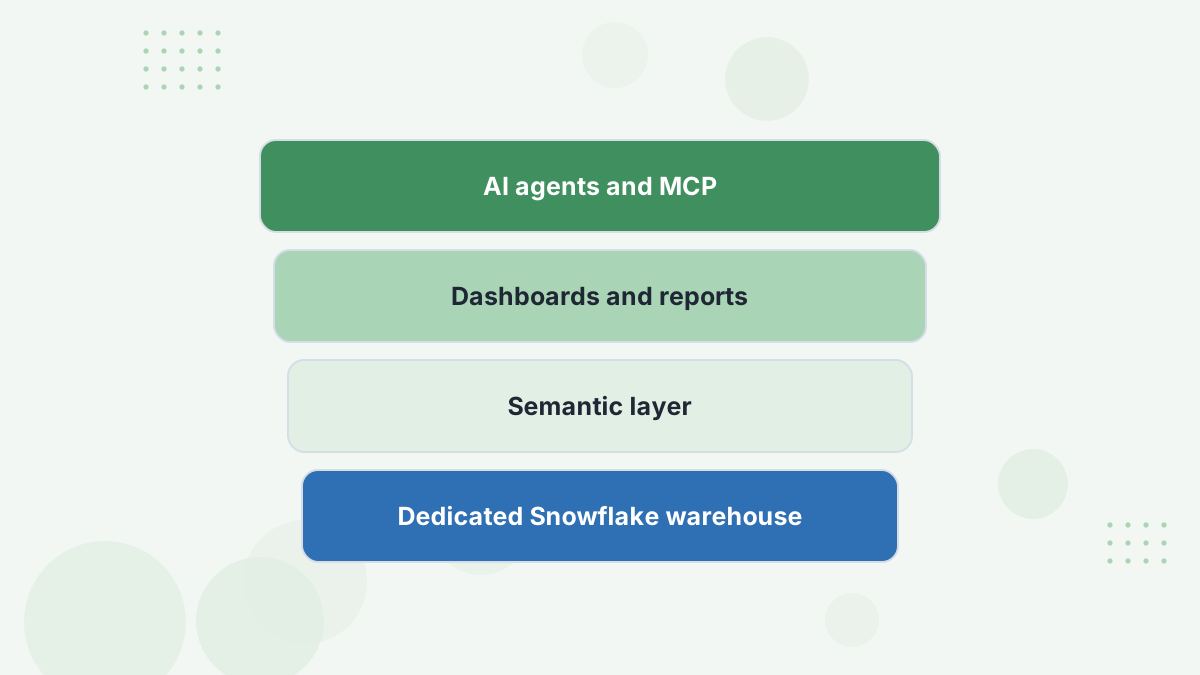
This is Polar's clear advantage. Dashboards, custom reporting, Ask Polar AI and alerts sit on a dedicated warehouse with hundreds of metrics and dozens of connectors. Polar's Headless MCP offers AI agents access to that data with frequent refreshes.
Hyros offers reports built around attribution, an AI analyst and a Claude MCP interface, but it isn't trying to be your company's BI stack.
If you'd otherwise hire a data engineer to build a warehouse, Polar's infrastructure is valuable. If you already have BI tools, Hyros's focused attribution may be the missing piece.
Pricing
Polar doesn't publish prices; plans are based on annual GMV and quoted after a demo, with a Core bundle and a Custom plan. Incrementality testing is priced separately.
Hyros publishes its entry tier, $69 a month for up to $5,000 tracked monthly revenue, and quotes larger tiers by tracked revenue with every feature included. See Hyros pricing.
Which Should You Choose?
Shopify Brand Wanting a Data Stack
Polar Analytics, for BI, warehouse and AI agents in one.
Shopify Brand Focused on Ad Spend
Hyros, for precise ad-level revenue and platform feedback.
Store Plus Subscriptions or Coaching
Hyros, for tracking beyond the Shopify checkout.
Brand Running Lift Tests
Polar, which offers incrementality testing.
Also comparing Shopify tools? See Hyros vs Triple Whale and best attribution software for Shopify.
Hyros vs Polar Analytics FAQs
How much does Polar Analytics cost?
Polar doesn't publish prices. Plans are based on annual GMV and quoted after a demo.
Does Polar work outside Shopify?
Polar is built for ecommerce brands, with Shopify as its core focus.
Does Hyros include a data warehouse?
No. Hyros focuses on attribution and offers API access for exporting data.
Can you use both?
Yes. Some brands use a BI stack for reporting and a dedicated attribution tool for ad decisions.
See Ad-Level Revenue You Can Trust
Book a Hyros demo to see your store's orders attributed across every ad platform.
Book a Hyros Demo